
First, there is a lot of miss-information about Lye (aka NaOH, Sodium Hydroxide or Caustic Soda) on the internet.
It seems like the Vested Interest doesn’t want people to use Lye anymore (it’s an ingredient used to make Meth).
I’ve even seen supposed pictures of Lye burns (on Wikipedia) that are actually caused by Potassium Hydroxide (KOH) not Sodium Hydroxide (NaOH).
And the ‘pure hydrogen’ (aka molecular hydrogen) machine manufacturers, distributors and promoters spread miss-information about lye, which the ignorant then parrot and spread further. They do this because they KNOW that Brown’s Gas is about 30% more therapeutically effective over ‘pure’ hydrogen and they are trying to scare people into buying their obsolete technology.
I know this because I’ve worked with concentrated lye solutions for over 60 years (we used it to clean milking equipment on the Ranch I grew up on. I’ve literally been SOAKED with lye solution when a chamber we were working on burst and spilled a hot 50% solution all over me. It was at least 15 minutes before I could take off my clothes and shower. I didn’t even get a rash.
Of course you don’t want it in mucus membranes or in open wounds because it’ll sting like the dikkens, just like any strong soap solution would.
Second, lye is one of the most common chemicals in existence. It’s used in hundreds of products and processes (see below). It forms naturally in the environment whenever there is a forest fire (Lye can be acquired by leaching water through wood ashes) and it is NEEDED by the environment to prevent natural water from getting too acidic.
In the past (for hundreds of thousands of years, until modern chemicals replaced it) lye was used to make soap and it was acquired (made) by simply pouring water through wood ashes and evaporating the water. It was also specifically used to preserve FOOD!
In other words, lye is the active ingredient in soap which we spread all over our bodies and wash our clothes, etc., as God originally intended us to use and we did use since the beginning of time… Until we discovered ‘chemistry’ and made franken-cleaners.
Third, see the FDA and EPA regulations at the bottom of this page.
The FDA allows up to 1% of lye in food, which is about 10,000 ppm
The FDA advises 30-60 mg/L (= 30-60 ppm) of lye in water (for taste)
EPA Municipality drinking water guidelines go up to 100 ppm
The World Health Organization has established a drinking water guideline of 200 mg of sodium/L (200 ppm) on the basis of esthetic considerations (i.e., taste).
Many people add sodium ‘salts’ (like Sodium Chloride, Sodium Bicarbonate and Sodium Hydroxide) to water for taste.
Sodium is essential for health and studies of water concentrations up to 1000 ppm sodium do not seem to have direct health issues.
You mix up the lye solution just like mixing Kool-Aid and the concentration we use for the AquaCure (about 1% by weight) is no stronger than liquid soap (which you could use it for if you wanted). Lye is mixed with fats or oils to make soap bars.
Lye can be acquired by draining water through wood ashes, then evaporating the water. So lye is a 100% natural substance that nature uses to prevent acidity in water after forest fires. Nature NEEDS it for health of… everything.
Today lye is commonly found in homes as drain cleaner, oven cleaner, etc…
Of course at MUCH higher concentrations than the AquaCure uses and people are not afraid of those household products…
I started using Brown’s Gas for heath purposes in 2005 and I’ve been inhaling it for an average of 8 hours (sometimes up to 12 hours) every day since March of 2016, for several of those years WITHOUT using a Humidifier, I’d just bubble through my Drinking Water jar, then drink the water as well.
I DESIGNED the AquaCure to have ONLY pure gas to be inhaled. The Humidifier is redundant backup safety that I didn’t even use in my own home machine. Normally the Tower Cap takes out most of the lye mist.
https://youtu.be/MG8FK7kswnM
Brown’s Gas contains nothing that isn’t supposed to be in your body. The ‘impurities are in the tiny solution droplets that can get carried out with the gas, The Humidifier traps those droplets, scrubbing the gas. There is ZERO chance of inhaling lye if you even follow just the spirit of the instructions of our AquaCure Operation Manuals and Updates.
We have many thousands of these machines being used worldwide. If you add in the ‘other’ manufacturers of Brown’s Gas machines, there are hundreds of thousands. Many people inhale all night, every night. No one has ever (legitimately) reported inhaling lye.
The bigger issue is people inhaling TOO MUCH HYDROGEN (too much is combustible) promoted by ignorant or greedy manufacturers.
I have seen where people report the FEAR of inhaling lye and for them I say… TEST THE WATER. Using an inexpensive Total Dissolved Solids (TDS) meter and start with 0 TDS (distilled) water, and see for yourself that the TDS does not significantly rise in the Drinking Water jar (well under recommended limits).
Note that the ExW portion of Brown’s Gas will add electrons to the water that will cause SOME rise in the TDS reading that is NOT lye (TDS meters read ionizable constituents and adding electrons (ExW) skews that reading).
LONG before water has ‘too much’ lye, you will SMELL the ‘skunky’ or TASTE the ‘funky’.
If the water smells/tastes good, it is good.
The water in the Humidifier effectively traps any residual lye mist (you’ll see the TDS in the Humidifier gradually rise).
Further a pinch of lye (NaOH) in water is actually healthy, is used to treat municipal water and is often used as a ‘buffer’ to adjust (raise) the pH of foods and condiments.
https://www.tomsofmaine.com/our-promise/ingredients/sodium-hydroxide–
If people are not inhaling the Brown’s Gas from the AquaCure, they are only getting 10% of the health gains they could be achieving with this technology.
https://eagle-research.life/about-me/
There is NO safer Brown’s Gas machine in the world than the AquaCure. I’ve been selling Brown’s Gas machines since 1986 and in all that time (well over 100,000 users) not one person that follows our guidelines has ever been hurt in any way.
And I’m small potatoes… In Asia Brown’s Gas is BIG and commonly used for a variety of applications. Japan even uses it in their health spas.
Studies are showing Brown’s Gas to be the next generation of Water for Health. Therapeutic results exceeding pure hydrogen for several reasons that mostly involve the ExW constituent.
Lye Notes:
Note that water having ‘memory’ of lye is GOOD 🙂
Sodium (Na) IS one of the molecules that the body NEEDS to be healthy.
https://healthhearty.com/sodium-deficiency
It is easily ingestible as Sodium Chloride (NaCl or table salt) but is more healthily ingested as NaOH (sodium hydroxide) because as the body removes the Na from table salt, it needs to get rid of the toxic substance Cl (chlorine). When the body removes the Na+ from NaOH, it is left with the hydroxide OH- which can quickly form into water (H2O)
https://en.wikipedia.org/wiki/Hydroxide
which is generally neutral in the body (not a poison like chlorine).
http://www.molecularhydrogeninstitute.com/hydroxide-oh-antioxidant-radical-or-neither
NaOH (lye) is often used in food and on food (just like sodium chloride). For example as a pretzel glaze:
https://culinarylore.com/food-science:how-do-pretzels-get-shiny-brown-surface/
You can literally search for ‘FOOD GRADE’ lye, for culinary applications.
NaOH is also used to adjust the pH of municipal drinking water (most people are ALREADY drinking lye):
https://drinking-water.extension.org/drinking-water-treatment-ph-adjustment/
https://www.denverwater.org/your-water/water-quality/lead/ph
So ANY level of NaOH in the water below the threshold of ‘caustic’ is benign and even healthful to drink.
Of course ANYTHING is toxic if you get too much of it. Even hydrogen can suffocate you is that’s ALL you inhale (no oxygen).
Note: People really need to get over their FEAR of lye. There is SO MUCH fear mongering going on out there, trying to make people afraid of EVERYTHING. Back on the Ranch, we used lye almost daily, for a lot of applications.
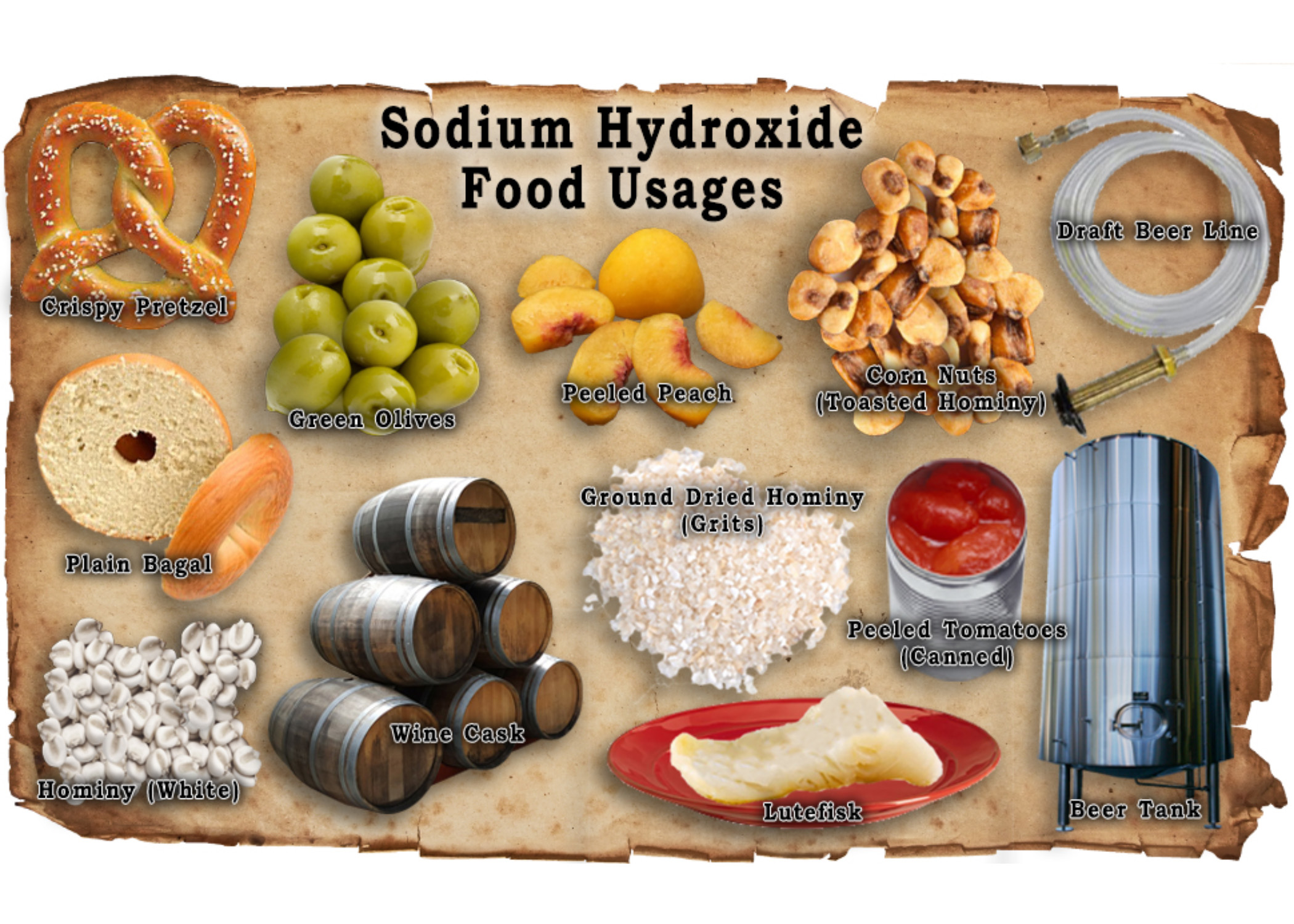
Lye (Sodium Hydroxide or NaOH) is one of the most USEFUL and beneficial substances we have.
https://sodiumhydroxide.weebly.com/uses.html
It’s created by nature everytime there is a forest fire and rainwater washes it into waterways to prevent the water from becoming too acid. So nature’s water naturally has lye in it.
People used to ‘make’ their own lye by leaching water through wood ashes. Now it’s made (commercially) by electrolysis of sodium chloride (table salt).
Lye curing: The powerful alkaline solution
Food-grade lye, while requiring careful handling, is a formidable preservative. Its extreme alkalinity makes bacterial growth nearly impossible.
It’s the key agent in transforming corn into hominy and curing raw olives. The process alters texture and flavor, but for creating shelf-stable foods in a long-term emergency, understanding safe lye curing is powerful knowledge.
Lye is generally NOT used to dissolve bodies like in the movies. Potassium hydroxide (KOH) is MUCH better at dissolving organic matter. Using NaOH can work but it takes a lot more and a lot longer.
On the ranch we use potassium hydroxide (caustic potash or KOH) to dissolve animal’s horn buds because sodium hydroxide (caustic soda or NaOH) is far too weak a caustic.
Speaking of wood ash (which has a lot of lye)
Wood ash: The alkaline protector
Don’t discard your hardwood ash. Its high alkalinity creates an environment where bacteria and mold struggle to survive. Cheese buried in sifted, clean wood ash within a crock will dry and harden, evolving in flavor and lasting for months.
More remarkably, meat packed in sifted ash inside earthenware vessels can remain stable for months. The key is using only clean, untreated hardwood ash.
Wood ash and clay burial: For the long haul
Taking ash preservation further, this method combines sifted hardwood ash with clay and salt. Meat is packed in this mixture, sealed in an earthenware vessel and buried.
The ash inhibits bacteria, the clay limits oxygen and the salt draws out moisture.
Archaeological evidence shows this was used for long-term storage across ancient civilizations. The result is a hardened, preserved product that is safe and stable.
I’ve personally been using lye all my life and most people have lye in their homes and don’t even know it. The most common uses are drain cleaner and oven cleaner (which works great on exhaust fan filters and greasy pots too).
https://www.youtube.com/watch?v=cvuIJhpsEXk
Further Uses of NaOH
Some Beauty Products links:
https://labmuffin.com/is-sodium-hydroxide-safe-in-beauty-products/
https://www.tomsofmaine.com/our-promise/ingredients/sodium-hydroxide-
Chemical matrixectomy
Phenol is commonly used in surgeries for ingrown toenails. It’s used on more severe ingrown toenails that don’t respond to other treatments. The phenol, in the form of trichloroacetic acid, is used to stop the nail from growing back.
A small 2001 studyTrusted Source of 172 people found that 98.8 percent of those who received a chemical matrixectomy with phenol cauterization had successful results.
However, phenol matrixectomy may be falling out of favor. A 2014 paper Trusted Source in the Journal of the American Podiatric Medical Association found that sodium hydroxide had fewer complications than phenol as an ingrown toenail treatment.
PubMed
https://pubchem.ncbi.nlm.nih.gov/compound/Sodium-hydroxide
Food Additives
Cosmetics Buffer
FDA:
The FDA allows sodium hydroxide (NaOH) as a food additive in levels not to exceed 1% in food products, but specific limits for municipal water are regulated by the EPA, which sets legal limits on contaminants to protect human health. Sodium hydroxide is commonly used in water treatment processes, but the exact permissible levels in municipal water can vary based on local regulations.U.S. Environmental Protection Agency
FDA Regulations on Sodium Hydroxide in Municipal Water
Legal Limits
The FDA does not set a specific limit for sodium hydroxide (NaOH) in municipal water. Instead, sodium hydroxide is regulated as a food additive when used in food processing, with a maximum allowable concentration of 1%.
Role in Water Treatment
Sodium hydroxide is often used in water treatment processes to adjust pH levels. This helps to prevent corrosion in pipes and improve water quality. However, the Environmental Protection Agency (EPA) oversees the safety of drinking water, including the regulation of contaminants.
EPA Standards
The EPA sets legal limits on over 90 contaminants in drinking water, ensuring that water systems can achieve these standards using the best available technology. While sodium hydroxide itself is not listed as a contaminant, its use in water treatment must comply with EPA regulations to ensure safety for public health.
Summary of Regulatory Bodies
| Regulatory Body | Focus Area | Sodium Hydroxide Regulation |
|---|---|---|
| FDA | Food Additives | Max 1% in food processing |
| EPA | Drinking Water | Sets limits on contaminants, oversees water treatment practices |
Sodium hydroxide is essential in water treatment but is regulated indirectly through broader drinking water safety standards.
https://www.epa.gov/sites/default/files/2014-09/documents/support_cc1_sodium_dwreport.pdf
National Science Foundation (NSF) safety certification
https://www.nsf.org/water-systems/treatment-chemicals-media/drinking-water-treatment-chemicals
https://blog.ansi.org/ansi/nsf-ansi-60-2024-drinking-water-chemicals-health/
https://blog.ansi.org/ansi/nsf-ansi-can-600-2024-chemicals-in-drinking-water/